
There has been a remarkable shift in society’s use of the internet. With the publication and expansion of A.I. models like generative AI and large language models (LLM), educators are faced with a new decision on how to incorporate, or ban, its use in the classroom. Some view AI as a tool, whereas others fear its effects on critical and creative thinking. In this week’s reflection, I will be outlining my own views on where, when, and how to use Generative A.I. and LLMs ethically and responsibly in the classroom.
What is it?
Generative Artificial Intelligence is tool that can generate new content such as text, images, and videos. An example of this is ChatGPT, which can generate an output based on extraction of multiple different internet resources. The more the source is used, the more ‘accurate’ it becomes. This does not mean ChatGPT is never wrong; the system is extracting data from human-generated content and cannot decipher factual from fictional. That means as an educator, we must be critical of the content that Gen A.I. platforms create and teach our students how to do the same.
When Should I Use it?

According to the School District No. 5 policies surrounding the use of Artificial Intelligence within schools, all staff should adequately train and educate themselves in the tool before attempting to use it. EKTEP recently facilitated a workshop on the use of AI which I found to be extremely informative. We discussed ethical uses, common assumptions and/or fallacies about AI, as well as its benefits in the classroom.
Developing an understanding of how AI platforms like Large Language Models (LLMs) work can take time and some effort. What is most important is to understand that these programs are not 100% accurate. These models accumulate and gather data from human-entered resources. That means that it too can be very susceptible to giving misinformation.

Using AI should serve as either a collaborative or supplemental process, not a replacement of your responsibilities. For example, asking ChatGPT to write a paper on the Industrial Revolution is replacing all of the critical thinking and reflective processes you would be expected to do. Instead of asking the model to write your paper, you could perhaps ask the program to find reputable resources that cover this topic. That being said, you must do your due diligence of vetting all answers it gives to you. This has also been outlined in the SD5 policy.

Using AI should not be used to replace a challenge. In fact, pursuing, overcoming, and achieving challenges is a vital and important part of our personal growth. What this means is we must find balance between limited thinking/low stress and instances causing a high cognitive over-load.
“How can we stay open to the discomfort of learning, rather than using AI to smooth it away too quickly?” – Kelly Fyke, AI Literacy for Educators Presentation
Why Should I learn about AI?
Whether we like it or not, AI is here to stay. Programs are becoming faster, more powerful, and are creating content that is sounding more and more human-like. Its features can be tempting to use as more than a tool but a complete crutch for any challenge that is thrown our way. That means it is important to learn not only for ourselves on how to use it in an appropriate and ethical manner, but to teach our students to do the same.

- Show students that AI can make mistakes.

Here we see an inaccurate map of Canada created by ChatGPT-5. This would be a great example to show to a group of students to reveal that even the most up-to-date AI models can make very silly mistakes. You can also make this into a hands-on learning opportunity, where you ask the students to see if they can ‘trick’ AI. For example, you can ask AI to explain a made-up theory and see what answer it provides.
2. Have a discussion on the risks and impacts
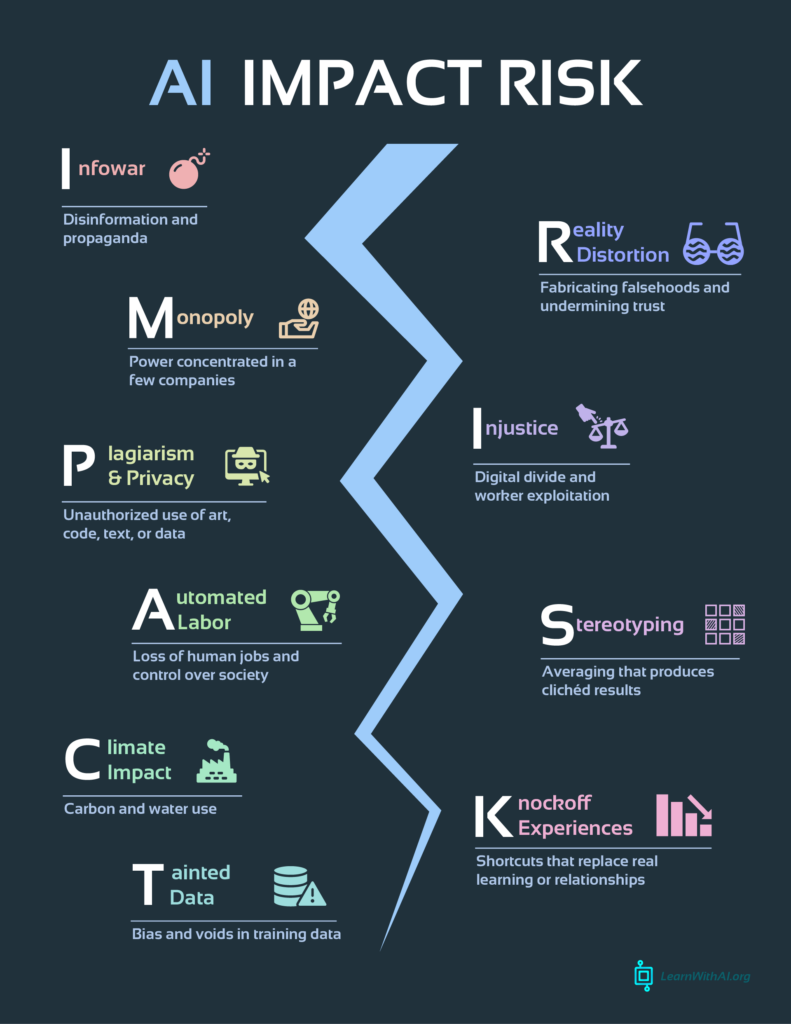
AI has many benefits as well as many risks. Take a moment to reflect on these with your students. Provide real-world examples, and ask students what they have heard or seen. This is not intended to scare them away from using this resource. Rather, the purpose is to ensure every person is informed and educated on how AI programs operate.
3. Show the opportunity
For our group inquiry assignment, our team researched virtual field trips, which is a virtual, immersive, and interactive way to explore space, time, and different geographical locations without ever stepping foot outside of the classroom. This opens so many doors for students whose opportunities to participate in field trips were hindered by accessibility requirements, language barriers, or financial reasons.